The venue drives nearly every other decision you will make. It determines your guest count, your caterers, your timeline, and a significant part of your budget. Get it right and the rest of planning falls into place. Get it wrong and no amount of beautiful flowers will fix it.
Tuscany has no shortage of beautiful properties. That is precisely the problem. Vineyards, stone villas, medieval hilltop estates, working agriturismi: the region offers them in genuine abundance, and they are not interchangeable. Each type comes with its own logistics, its own vendor culture, and its own set of constraints.
This guide covers what actually matters when choosing your wedding venue in Tuscany.
Why the venue shapes everything else
Think of the venue as the frame around the rest of your day. It sets the visual register, limits or expands your supplier options, and establishes the guest experience before anyone sits down to dinner.
The style of the space defines the tone: a formal villa reception reads differently from a long table in an olive grove.
Capacity, parking, and on-site accommodation affect how comfortable your guests actually are.
Catering options, noise ordinances, and curfews shape your program.
Venue hire typically accounts for 40 to 50 percent of total wedding spend, so the choice has direct financial knock-on effects.
Define your style before you tour anything
The most common mistake couples make is touring venues before they have agreed on what kind of wedding they are planning. Style is not a superficial consideration. It determines the geography you should be looking at, the vendor relationships you will need, and what your guests should expect.
A civil ceremony on a Chianti vineyard terrace is a fundamentally different experience from a church wedding in a hilltop borgo followed by a reception in a Renaissance villa. Both are in Tuscany. Both can be done well. But they require different vendors, different logistics, and different expectations from your guests.
In Tuscany, the main options are:
Traditional and formal: historic villas, ballrooms in restored palazzos, ceremonies in Romanesque churches with receptions at an estate nearby
Rustic and agricultural: working agriturismo properties, stone farmhouses surrounded by vines or olive groves, barn-style spaces
Destination and scenic: properties positioned primarily for landscape, particularly in the Val d’Orcia or the Crete Senesi & Chianti
Intimate and small-scale: private villas suited to 20 to 35 guests, often the most flexible in terms of customization
Modern and minimal: a smaller category in Tuscany, concentrated in Florence
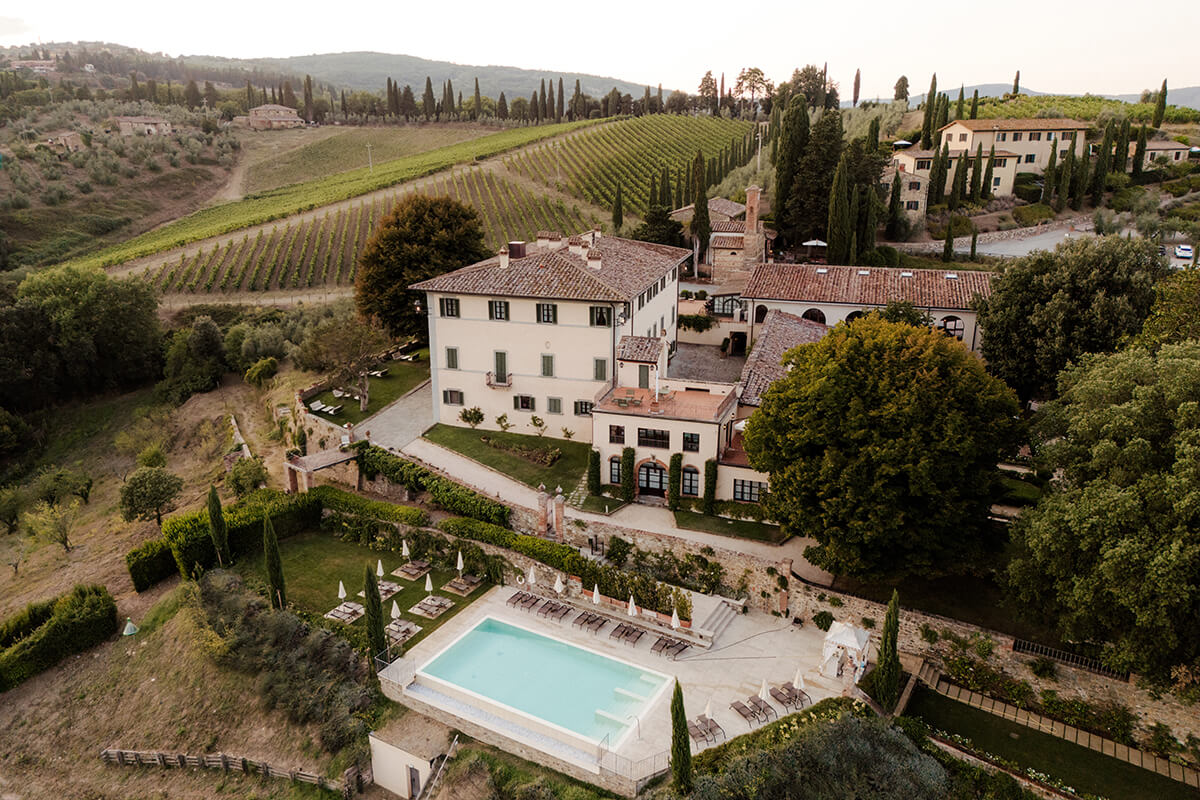
A working estate in the Chianti hills. Accommodation, ceremony space, and reception all on one property, makes logistics more fluid.
Settle your guest count before booking any tours
Capacity drives more decisions than couples realize. A property that works beautifully for 60 guests often becomes logistically complicated at 100. Table configuration, catering setup, dance floor space, parking, and shuttle requirements all scale with headcount.
Aim for a realistic number before you contact venues. Then understand how that number maps to actual space. A venue licensed for 100 guests at a seated dinner may only comfortably accommodate 80 for a standing ceremony in the same location. Different spaces on the same property have different effective limits.
When you tour, ask the coordinator to walk you through the full day in spatial terms: where the ceremony happens, where guests move for cocktails, where dinner is held, and how the transitions work in practice.
Budget: what the quote actually includes
Venue hire in Tuscany typically accounts for 40 to 50 percent of total wedding spend. That figure can rise quickly if you are not precise about what is and is not included in the initial quote.
Ask for a full itemized breakdown. Some venues include tables, chairs, linens, basic AV, and lighting. Others provide only the space: every rental item is cost separately. Service charges, cleaning fees, IVA (Italian VAT, currently 22%), and overtime rates can add 20 to 30 percent on top of the headline number.
All-inclusive venues simplify coordination and often reduce total spend, but they restrict your choices. You may be required to use their in-house caterer, their preferred florist, or a list of approved photographers. If you have specific vendors in mind, confirm their eligibility before you fall in love with a property.
A venue with a lower rental fee but a closed supplier list is not necessarily the cheaper option.
Location: geography matters more than it looks
The main zones
Tuscany is large. Florence to the southern Maremma coast is nearly three hours by car! The main areas for weddings each have distinct characteristics:
Chianti Classico: between Florence and Siena, well-developed infrastructure, the most recognisable vineyard landscape, higher venue density and corresponding price.
Val d’Orcia: more remote, the iconic cypress-lined landscape of most Tuscany photographs. Limited local accommodation means guests typically need transport from Siena or Montalcino.
Lucca and the Garfagnana: less touristed, strong villa culture, closer to Pisa airport, good for couples who want privacy over scenery.
Maremma coast: suits couples who want beach access combined with Tuscan countryside, though the landscape is less typical of the region.
Guest accessibility
Consider how your guests are arriving. Pisa and Florence both serve as entry airports, with Florence better positioned for central Tuscany and Pisa more convenient for Lucca and the northwest.
Transportation: shuttles from a central pick-up point are standard practice for remote venues.
Accommodation: remote properties often require guests to stay in the nearest town. Factor this into your guest communications early.
Local regulations: noise ordinances and curfews vary by municipality. In some rural areas, outdoor music must stop by midnight or earlier. Confirm this before you commit to a venue.
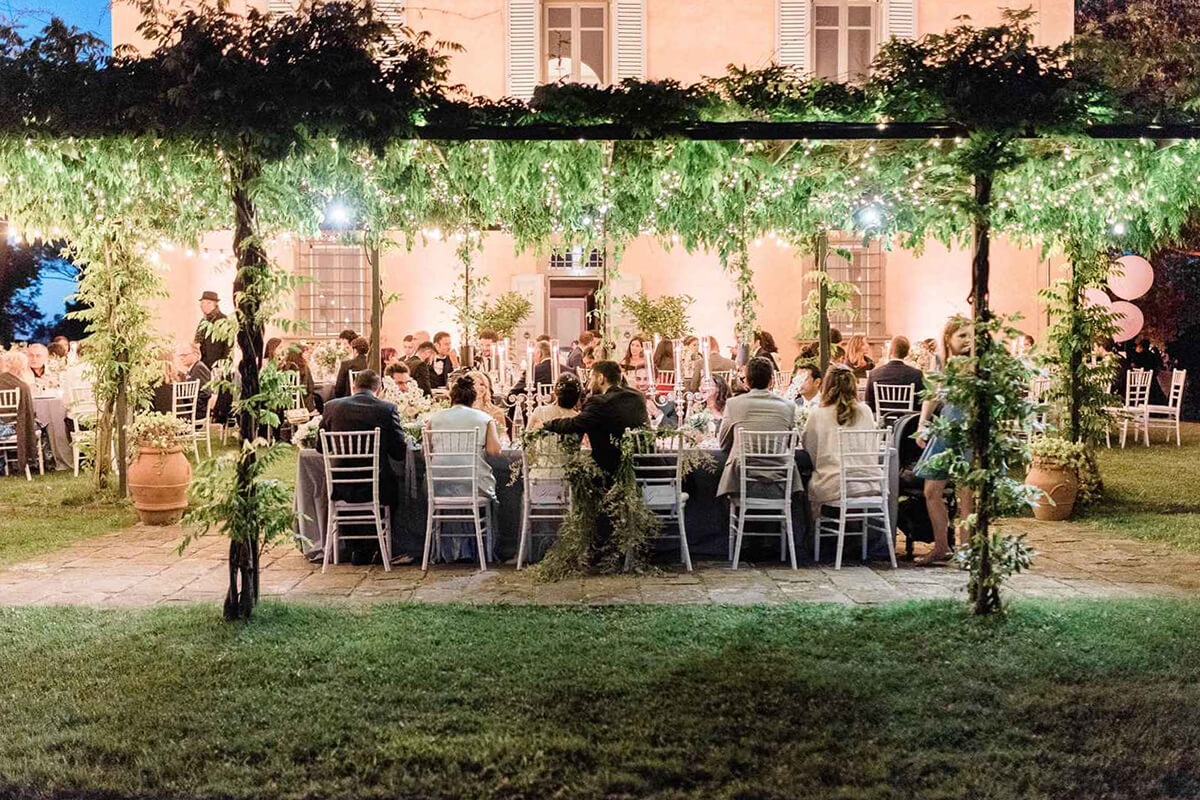
Tuscany works at any scale. A candlelit table for thirty under a pergola is a different experience from a reception for a hundred – not a lesser one.
Visit venues in person
Photographs of a venue and the experience of being in it are rarely the same thing. Proportions, natural light, the quality of the stonework, the view from the ceremony spot: these things read differently on a screen.
Take your own photos and notes during each tour. Impressions blur quickly when you are comparing several properties.
Ask specific questions: availability on your preferred date, restrictions on decoration and catering, vendor policies, and curfew times.
Pay attention to how staff respond during the tour. Coordinators who are slow to follow up before you have signed anything are not going to improve once you have.
Check what the venue actually provides
The gap between what a venue says it offers and what appears in the contract is where costs tend to accumulate. Confirm specifics in writing:
Furniture and linens: are tables, chairs, and tablecloths included, or are these rentals?
Sound and lighting: in-house systems, or do you hire an external company?
Catering: in-house kitchen, preferred caterer list, or open to external suppliers?
Accommodation: on-site rooms for the couple and key guests, or nearby options requiring separate bookings?
Parking and transport: is there space for guests who drive, and is shuttle access practical from the nearest town?
Accessibility: if any guests have mobility requirements, confirm lift access, hard-surface paths, and restroom facilities.
Match the venue to your visual plan
The architecture, landscaping, and interior finishes of a venue are not just backdrop. They determine how much decorating you need to do and what you can leave alone.
A well-restored stone villa may need very little decoration; an event tent on a vineyard requires considerably more.
Check indoor and outdoor options. Tuscany in June can be very hot in the afternoon; September evenings turn cool. You need a venue that works in both directions.
Think about photography in practical terms. The quality and direction of natural light in the ceremony and reception spaces will directly affect your photos. Ask when the sun sets in your chosen month and where it falls in each area of the property.
Understand the restrictions before committing
Every venue has rules. Some will matter to you, some will not. The important thing is to know them before you sign anything.
Decor limitations: candles, confetti, fireworks, and sparklers are restricted or prohibited at many Tuscan properties due to fire risk, particularly in summer.
Noise regulations: outdoor amplified music is often limited by local ordinance. Confirm the permitted end time for live bands and DJs.
Vendor policies: some venues require approved suppliers. Others allow full flexibility but charge a corkage or kitchen fee for outside caterers.
Alcohol: some venues require their own licensed bar staff. Others allow you to supply your own wine, which in Tuscany is often the better arrangement.
Assess how flexible the venue actually is
Things change between booking and the wedding day. Vendors drop out, guest numbers shift, weather causes last-minute adjustments. A venue with rigid policies will add stress at the worst possible moment.
Ask whether the event timeline can be adjusted if needed.
Ask what the contingency plan is for rain during an outdoor ceremony.
Confirm whether you can adjust table configurations or use different areas of the property for different parts of the day.
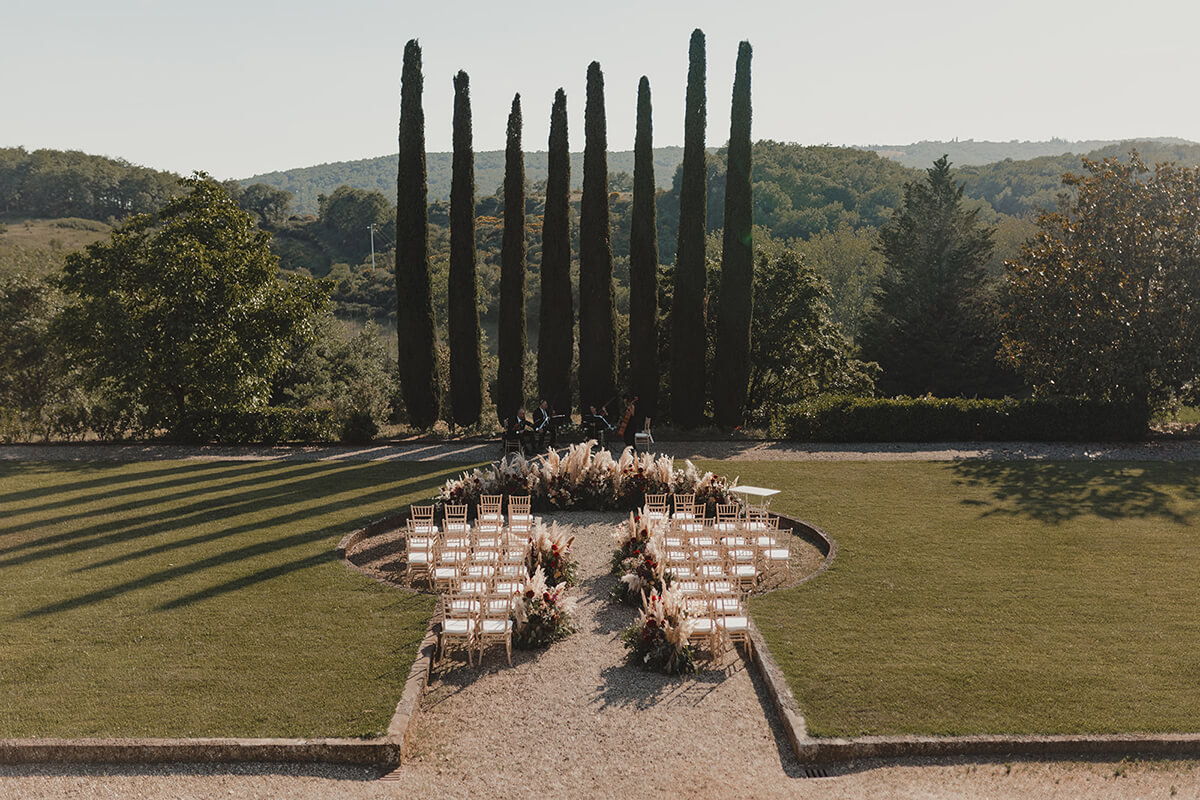
A ceremony set into the classic Tuscan landscape, framed by cypress. The geometry of the space is wedding picture perfect.
Book early, especially for peak dates
Well-regarded venues in Tuscany routinely book 12 to 18 months in advance for peak dates, which run from late April through to mid-October.
If you have a specific date in mind, start the venue search there rather than at the end of the process.
Weekday weddings and off-season dates (November through March) offer more availability and meaningfully lower hire costs.
Confirm that your preferred ceremony and reception timing fits the venue’s scheduling. Some properties run multiple events on the same day.
Read the contract carefully
The contract is where assumptions become binding commitments, in both directions. Do not rely on verbal assurances.
Review the cancellation policy and deposit structure. In Tuscany, deposits are typically non-refundable and can be 30 to 50 percent of the total venue cost.
Confirm exactly what is included: furniture, linens, staff, catering equipment.
Establish the overtime rate and when it kicks in.
Get any agreed variations to the standard package written into the contract before you sign.
A good planner will save you time and money on venue selection
A planner with genuine Tuscany experience knows which venues are reliably managed, which have changed ownership recently, and which look better in photographs than they perform in practice.
Planners have established relationships with venue coordinators and preferred suppliers. This matters when something needs to be resolved quickly.
They can shortlist venues that genuinely match your style, guest count, and budget rather than sending you on tours of properties that were never right.
At Tuscandream, the planning team handles venue selection as part of a broader coordination process covering supplier management, logistics, and on-the-day execution.
Making the final decision
Once you have toured several venues, compared the details, and reviewed the contracts, the decision usually becomes clearer than you expect. Most couples find that one or two properties have already separated themselves from the rest.
Weigh the options against your priorities: guest experience, logistics, visual fit, and budget.
Do not let the most photogenic venue win if the practical details do not add up.
Confirm your booking with a signed contract and deposit. In Tuscany, a date is not held without both.
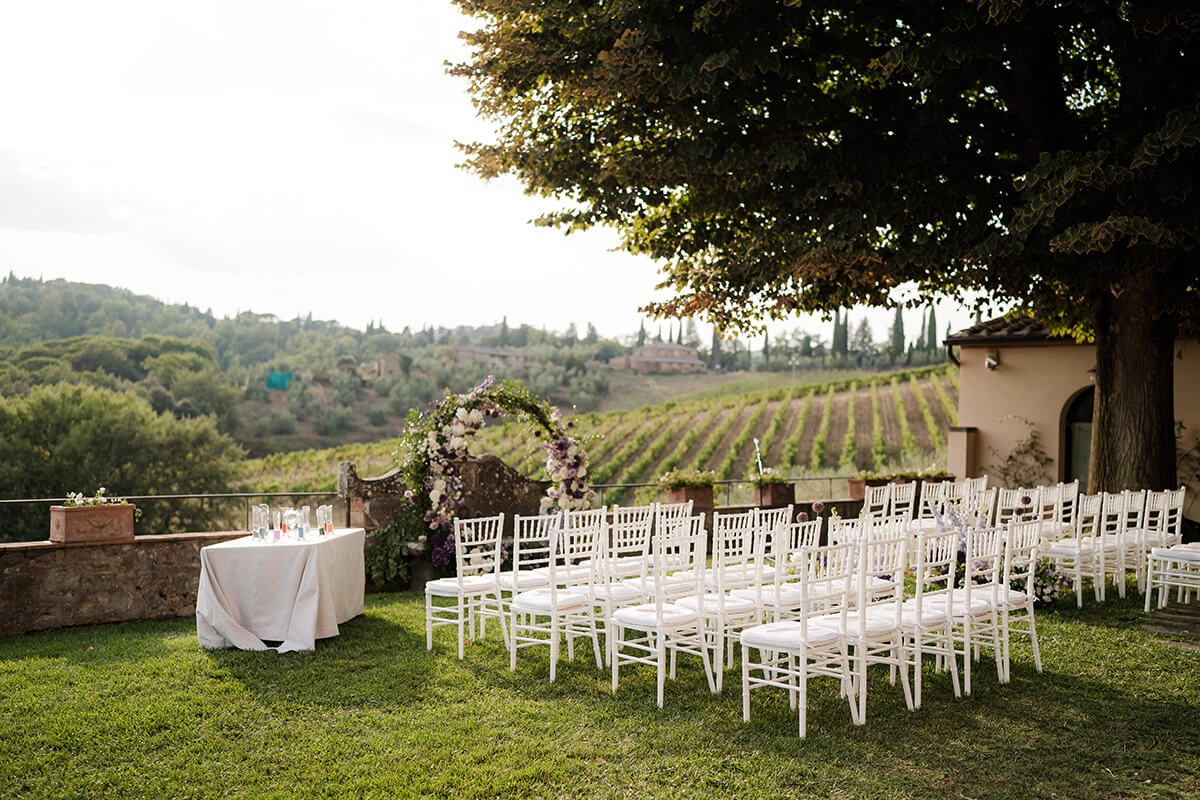
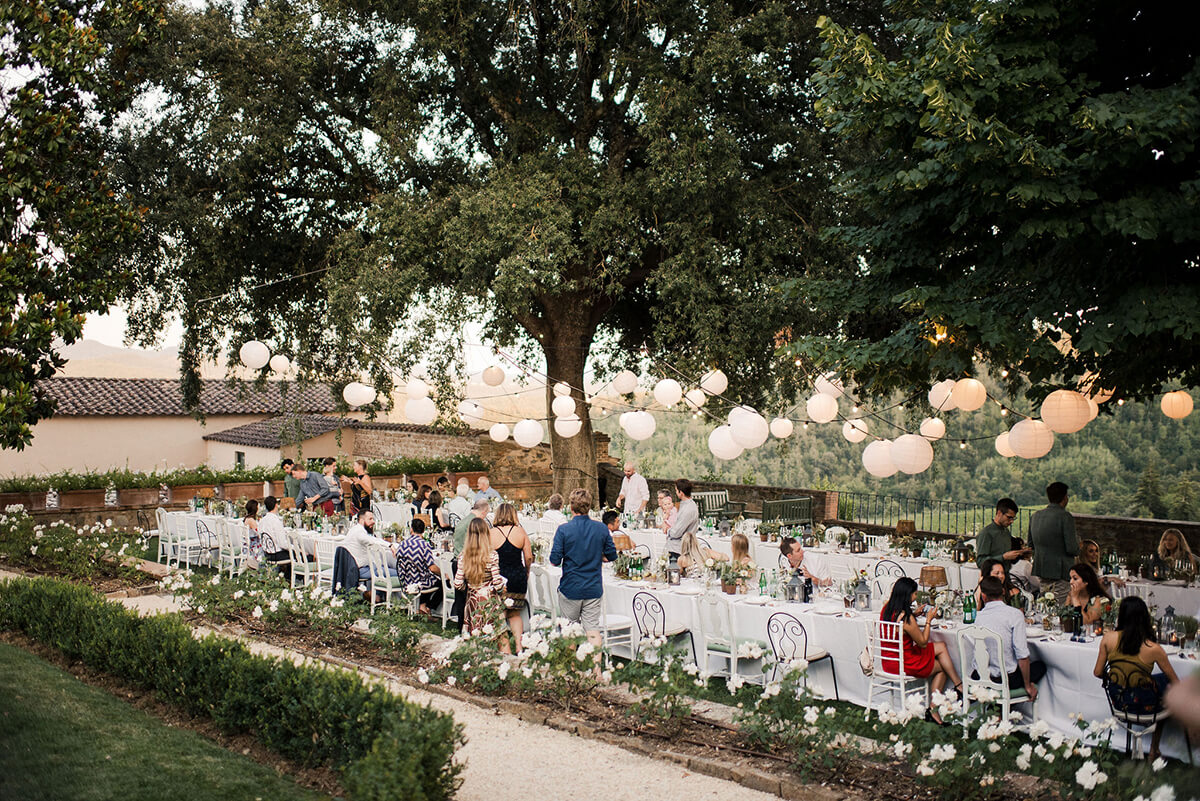
Long tables, paper lanterns, an old oak tree. Instead of extra florals, we let the garden speak for itself.
Practical notes for Tuscany specifically
Vineyard and hillside venues often have gravel paths and uneven ground. Worth flagging to guests in advance, particularly those with mobility issues.
Stone villas can be cold on spring and autumn evenings. Ask about heating options for outdoor spaces or terraces.
Natural decoration materials (olive branches, seasonal flowers, lanterns, candlelight) work well in Tuscan settings and tend to be cost-effective when sourced locally.
Indoor/outdoor flexibility is worth prioritizing. Even in peak summer, afternoon thunderstorms are not uncommon in central Tuscany.
Venue selection comes down to style, guest count, budget, amenities, location, and flexibility. Define your priorities in that order, visit the properties that genuinely fit, and read the contracts before you commit.
The right venue does not need to be the most expensive or the most well-known. It needs to work for the day you are actually planning. At Tuscandream, venue selection is the foundation of everything we build for a wedding, and it is where the planning process starts. Get in touch with us to see how we can help you choose the perfect wedding venue in Tuscany for you.